

Pelvic Organ Prolapse: What It Is, and Why It Doesn't Mean You Have to Stop Exercising
If you've ever felt a sense of heaviness or pressure low in your pelvis — especially after having a baby — and quietly wondered if something is "falling," you're not alone, and you're not overreacting. Pelvic organ prolapse is common, rarely talked about openly, and one of the most anxiety-inducing things a woman can experience without a clear explanation of what's actually happening.
Let's talk through it properly.
What Pelvic Organ Prolapse Actually Is
Pelvic organ prolapse (POP) occurs when one or more pelvic organs — the bladder, uterus, or rectum — descend toward or into the vaginal canal due to insufficient support from the pelvic floor and connective tissue.
It's common postpartum, particularly after vaginal birth, and it exists on a spectrum — from a mild sense of heaviness that some women don't even notice, to more significant symptoms. Many women with mild prolapse train and move through daily life completely normally, with some straightforward modifications.
The Most Important Thing to Understand
Prolapse does not mean you cannot exercise.
It means you need to manage load and pressure more thoughtfully than someone without it — not that movement itself is now off-limits. This distinction matters enormously, because the instinct after a prolapse diagnosis is often to stop moving almost entirely, which usually isn't necessary and can come with its own downsides (deconditioning, weight changes, mood effects) that don't actually help the prolapse itself.
A Way to Think About It: The Boat Analogy
Picture your pelvic organs like a boat, and your pelvic floor and connective tissue like the ligaments holding that boat steady in the water. When those ligaments are strong and well-supported, the boat sits securely, even when the water gets choppy. When that support is weaker, the boat sits lower and shifts more with the same amount of movement.
The goal of training with prolapse isn't to avoid "choppy water" forever — it's to strengthen and support the system so it can handle more of it over time, while working within what it can currently manage.
Watch It in Action
If you'd rather see this explained than read it, here's a short video where I walk through this concept (Click Here).
Understanding how your pelvic floor supports your organs — and what actually helps rather than harms as symptoms develop — is exactly what we work through step-by-step inside Strong From Within, building from breath and pressure control up to full movement confidence.
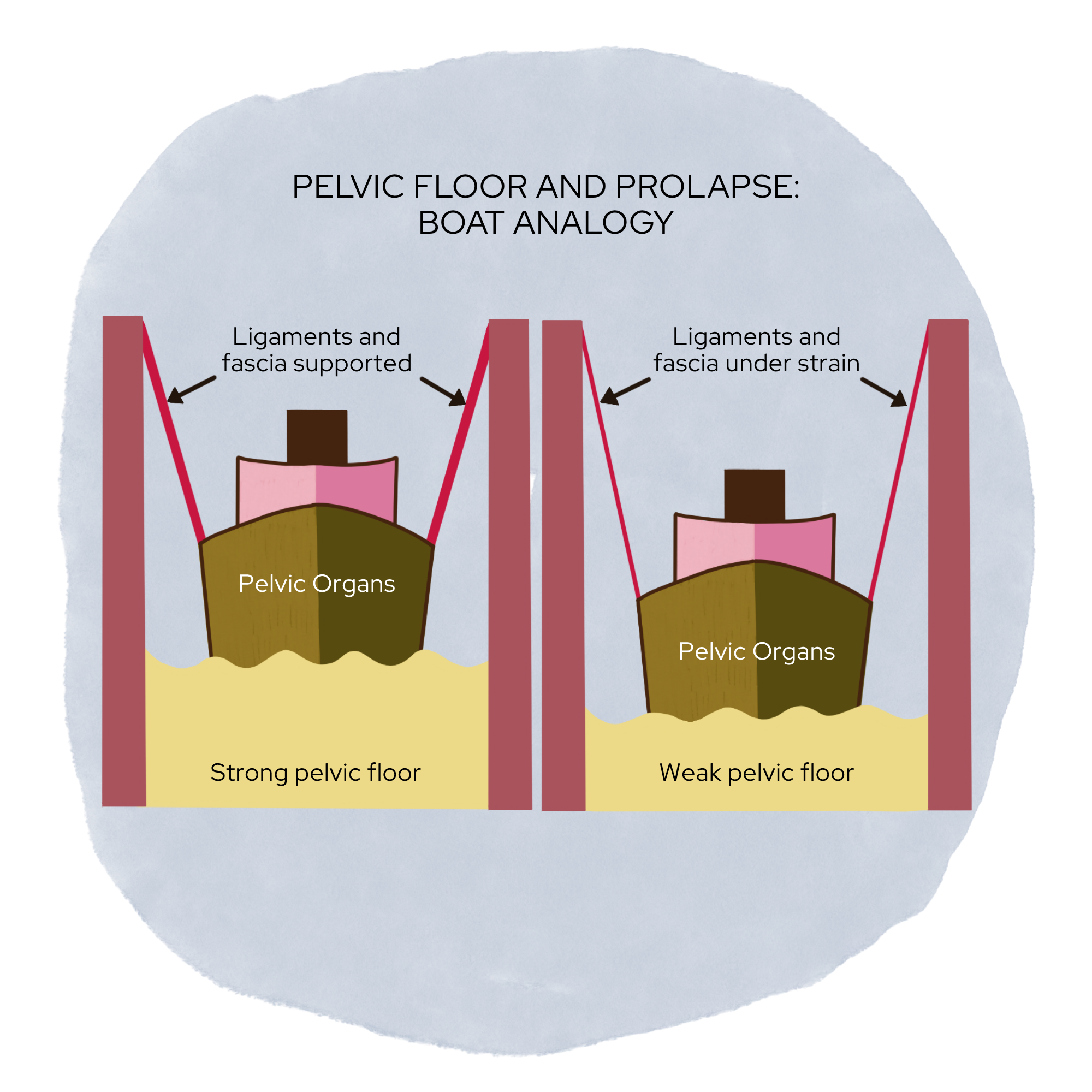
Illustration created by the talented Mégane Durozay @ meganedurozay.com
What to Watch For
A few signs are worth paying attention to, whether or not you already know you have prolapse:
A feeling of heaviness, fullness, or pressure in the pelvis
Pelvic pressure that worsens throughout the day or with activity
Urinary urgency, frequency, or a sense of incomplete emptying
Difficulty with bowel emptying
Low back or tailbone ache after standing or training
A sensation of something "falling out" or bulging at the vaginal opening
One useful rule of thumb: symptoms that increase during or within 24 hours of exercise are a signal to scale back — not a signal to stop entirely, just to adjust.
How Training Actually Needs to Adapt
The core principle is managing intra-abdominal pressure so it doesn't exceed what your pelvic floor can currently support. A few things that apply across the board:
Exhale on the effort. Never hold your breath during exertion — this is the same principle that shows up in every part of pregnancy and postpartum training, and it matters even more here.
Use partial pelvic floor pre-activation before lifts and transitions, rather than either no engagement or maximal, constant bracing. Both extremes — never engaging and never releasing — create problems.
Prioritize full relaxation between reps. Bracing constantly is just as much of an issue as not bracing at all. Your pelvic floor needs to move through a full cycle of engaging and releasing, not stay gripped indefinitely.
Stop if heaviness, pressure, or a bulging sensation appears mid-session. This isn't a sign of failure — it's useful, real-time feedback about your current capacity.
Posture Matters More Than People Expect
One detail that gets missed constantly: avoid tucking your pelvis under. An excessively posterior-tilted pelvis actually compresses the pelvic floor rather than supporting it. Aiming for a neutral lumbar curve during loading — think "long spine, soft ribs" rather than "squeeze and brace" — makes a real difference in how well your pelvic floor can do its job.
It's not just your lower spine that matters here, either. Thoracic kyphosis — the rounded, slumped-forward posture that tends to creep in from nursing, carrying a baby, or just general postpartum fatigue — changes where your rib cage sits relative to your pelvis. When the upper back rounds forward, the ribs tend to flare and the diaphragm loses some of its ability to move efficiently with each breath. That shift changes how pressure moves through your torso with every breath and every effort, often directing more of that pressure downward onto the pelvic floor instead of distributing it evenly through a well-stacked ribcage-over-pelvis position.
In practice, this means posture isn't just a "sit up straight" comment — an upright thoracic spine genuinely gives your pelvic floor a better mechanical setup to do its job, especially during the exact activities (nursing, carrying, lifting) that tend to pull posture in the opposite direction during the postpartum period.
What About Pessaries?
You may have come across mentions of using a vaginal pessary — a supportive device fitted into the vagina — proactively in the postpartum period, not just after a prolapse diagnosis. This is an area of active research, and it's worth understanding accurately rather than as a simple "do this and prevent prolapse" tip.
A few studies have looked at postpartum pessary use, and the results so far are mixed. Some data shows pessary users experiencing greater improvement in pelvic floor symptoms over the first year postpartum; other analyses of similar postpartum pessary programs found no significant difference in prolapse symptoms specifically, and in some cases worse urinary symptoms among pessary users. Much of this research also hasn't been done as a randomized trial — women often self-select into using a pessary or not, and those who choose to use one frequently start with more pronounced symptoms already, which makes the results harder to interpret cleanly.
The summary: postpartum pessary use is a promising area of ongoing research, not yet an established, proven prevention strategy. A pessary also isn't something to self-select and insert without guidance — proper fitting by a provider matters for both comfort and effectiveness. If you're curious whether early pessary use makes sense for your specific situation, it's a great question to bring directly to your OB, midwife, or a pelvic floor specialist, rather than something to start on your own based on general research.
When to Check In With Your Provider
A few situations are worth a direct conversation with a pelvic floor PT rather than self-guided troubleshooting:
If you have confirmed or suspected higher-grade prolapse, getting a pelvic PT assessment before adding significant load is worth doing proactively, not after something feels wrong
If symptoms worsen even after you've already scaled back for a couple of sessions
If you feel a visible or palpable bulge at the vaginal opening
Before returning to running specifically — a pelvic PT can assess real-time load capacity in a way self-assessment can't capture
If pelvic pain develops, or intercourse remains painful beyond the expected early healing window
None of these mean something is wrong with you. They're simply signals that your specific situation deserves individualized eyes on it, rather than a general framework alone.
The Bigger Picture
Prolapse is one of the least openly discussed postpartum realities, which means most women navigating it are doing so with almost no real guidance — just fear and a vague sense that they should probably stop exercising. That gap is exactly what leads to unnecessary deconditioning, when in most cases, a well-sequenced return to training is entirely possible.
This is exactly what the postpartum module inside Strong From Within is built to address — practical, symptom-aware guidance for training with prolapse, alongside the rest of your postpartum recovery, built by a doctor of physical therapy who treats this every day.